MiCA regulation has changed the rules for crypto in Europe. The EU’s Markets in Crypto-Assets Regulation now determines which companies can legally provide many crypto services, what protections apply to customers, and how stablecoins and other crypto-assets can be offered across the European Economic Area. The biggest change is no longer theoretical. Since the maximum transition period ended on 1 July 2026, crypto-asset service providers that relied on older national registrations can no longer simply continue operating without MiCA authorisation. That has forced exchanges to obtain licences, migrate European customers to regulated entities, restrict products, or pull back from some markets. For users, the practical question is therefore not just “What is MiCA?” It is also: who is actually authorised, what happens if your exchange is not, and what protections does a MiCA licence really give you? This guide answers those questions and explains where the rules may go next.
What Is MiCA Regulation?
MiCA stands for Markets in Crypto-Assets Regulation. Formally, it is Regulation (EU) 2023/1114, the European Union’s common framework for crypto-assets and crypto-asset services that are not already covered by existing EU financial-services legislation.
That last part matters. MiCA is not a law covering every financial product built using blockchain technology. Crypto-assets that already qualify as financial instruments, deposits, certain funds, securitisation positions and other products covered by existing EU financial legislation remain under those frameworks instead. MiCA mainly creates rules for two broad groups.
The first is issuers of crypto-assets, including special regimes for asset-referenced tokens and e-money tokens.
The second is crypto-asset service providers, or CASPs. These include businesses providing services such as custody, crypto-to-fiat exchange, crypto-to-crypto exchange, execution of orders, operating trading platforms, portfolio management and transferring crypto-assets on behalf of customers.
Before MiCA, crypto regulation across the EU was considerably more fragmented. A provider might operate under one national registration regime while facing very different requirements elsewhere. MiCA replaces much of that patchwork with a common regulatory framework.
When Did MiCA Come Into Force?
MiCA did not begin applying all at once. Rules covering asset-referenced tokens and e-money tokens became applicable on 30 June 2024. The broader regime, including the rules for crypto-asset service providers, became applicable on 30 December 2024.
Existing providers were nevertheless allowed to continue temporarily under national transitional arrangements. Article 143 permitted qualifying firms to operate until 1 July 2026, or until their MiCA authorisation was granted or refused, whichever happened first. Member States could also shorten that transitional period.
That distinction is important because for much of 2025 and the first half of 2026, an exchange could legally serve customers in some European countries without yet holding a MiCA CASP authorization. The maximum transitional period has now ended.
From 1 July 2026, providers relying only on the old transitional regime can no longer continue providing MiCA-regulated crypto services without the required authorisation. Luxembourg’s CSSF, for example, explicitly told customers after the deadline to verify whether their provider remained authorised and to consult ESMA’s register. This is why MiCA matters considerably more to crypto users now than it did when the regulation was first adopted.
What Is a MiCA CASP Licence?
A company that wants to provide covered crypto-asset services in the EU generally needs to be authorised as a crypto-asset service provider, unless it falls under provisions allowing certain already-regulated financial institutions to provide those services.
A MiCA authorization is granted by the relevant national competent authority. Once authorized, a CASP can use the EU passporting system to provide its approved services across other EEA states without applying for a completely separate crypto license in every country. But there is an important detail that is frequently lost in exchange marketing: The license belongs to a legal entity, not to a brand.
“Coinbase,” “Kraken” or “Bybit” might be the name visible in an app, but customers in different regions can contract with entirely different companies inside the same corporate group.
ESMA’s MiCA register therefore records the authorised legal entity, regulator, services covered, host Member States and other information. The register was most recently updated on 9 September 2026 at the time of writing.
This distinction becomes especially important when a global crypto group offers regulated and unregulated products through different entities.
Which Crypto Exchanges Have MiCA Authorisation?
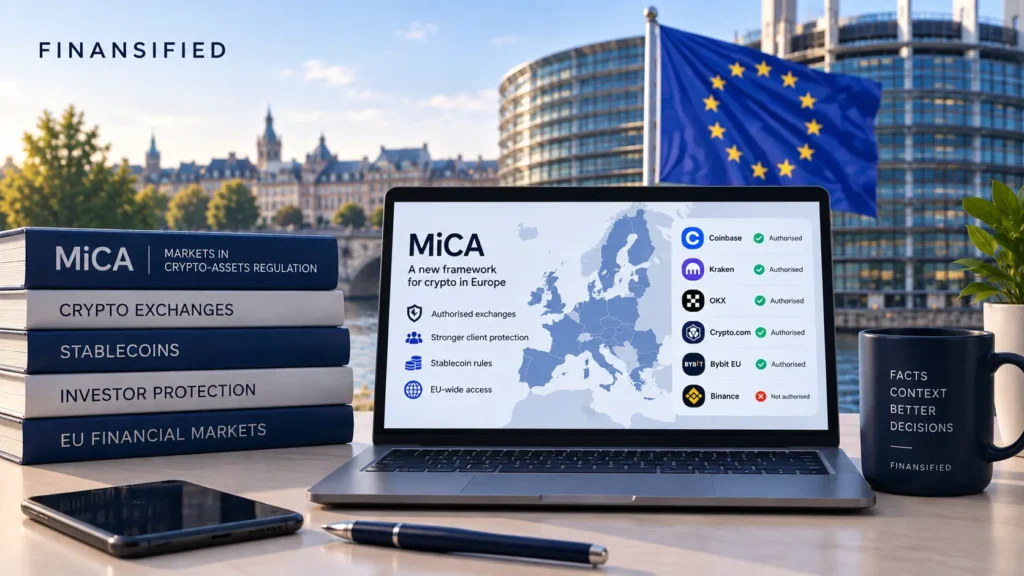
Several of the largest crypto platforms serving Europe have obtained MiCA authorisation. Others have not.
The table below focuses on major brands where the authorisation status can be verified through regulators, ESMA or the firms’ regulatory disclosures. Status can change, so the ESMA register should always be checked before relying on this information.
MiCA · European crypto regulation
MiCA Status of Major Crypto Exchanges in Europe
The key distinction is the authorised European legal entity, not simply the global exchange brand. MiCA authorisation can be passported across the EEA, but the licence applies to the named entity and the services it is authorised to provide.
| Exchange | MiCA status | European entity / regulator | What is interesting for clients |
|---|---|---|---|
| Coinbase | Authorised | Coinbase Luxembourg S.A. / CSSF, Luxembourg | European customers were migrated in phases to Coinbase’s Luxembourg MiCA entity. Coinbase updated contractual terms and cancelled existing open orders for affected users on their migration date, requiring those orders to be recreated after the new agreement was accepted. |
| Kraken | Authorised | Payward Europe Solutions Ltd / Central Bank of Ireland Payward Global Solutions Ltd is separately authorised to operate Kraken’s crypto-asset trading platform. | Kraken’s MiCA authorisations are passported across the EEA, but the EEA product universe differs materially from the global platform. Kraken currently restricts numerous crypto-assets and stablecoins for EEA clients. |
| OKX | Authorised | OKX Europe Limited / MFSA, Malta | OKX uses a dedicated European entity and passports its MiCA services across the EEA. The European offering is not identical to the global platform: some products and assets are unavailable or restricted, including USDT trading for European users. |
| Crypto.com | Authorised | Foris DAX MT Limited / MFSA, Malta | The CASP authorisation covers exchange, execution, transfers and custody and was passported across the EEA. In February 2026, Crypto.com’s EU MiCA entity also received a limited Maltese financial-institution licence for payment services relating to e-money tokens. |
| Bybit | Authorised via Bybit EU | Bybit EU GmbH / FMA, Austria | This is a useful example of brand ≠ legal entity: Bybit EU is the MiCA-authorised European platform. Access to certain Bybit Global services for EEA residents has been progressively restricted as the group shifts European users toward the regulated EU structure. |
| Bitpanda | Authorised | Bitpanda group — MiCAR authorisations in Germany, Austria and Malta Bitpanda GmbH is authorised by Austria’s FMA as a CASP. | Bitpanda deliberately obtained three MiCAR authorisations across the group rather than relying only on a single passported licence. That makes its regulatory structure unusual among large European crypto platforms. |
| Bitstamp | Authorised | Bitstamp Europe S.A. / CSSF, Luxembourg | Bitstamp Europe is authorised for custody, operating a trading platform, exchange, order execution, reception/transmission and transfers. It has notified cross-border crypto-asset services throughout the EU and EEA. |
| Gemini | Authorised | Gemini Intergalactic EU, Ltd. / MFSA, Malta | EEA customers contract for digital-asset services with Gemini’s Malta entity rather than its U.S. entity. The Malta CASP is authorised for services including custody, exchange and execution. |
| Gate | Authorised | Gate Technology Ltd / MFSA, Malta | Gate’s regulated European platform is operated by its Malta entity, which holds both MiCA CASP authorisation and separate payment-institution permissions. European users are therefore served through a distinct regulated structure rather than the global platform alone. |
| Binance | Not MiCA-authorised | No Binance CASP listed in the ESMA authorised-provider register reviewed 9 September 2026 Binance withdrew its Greek application in June 2026 and said it would pursue authorisation in another EU Member State. | This is the most important large-platform example of a MiCA authorisation not having been secured by the end of the transition period. Some European services faced restrictions while Binance continued to pursue another EU authorisation route in July 2026. |
| Bitget | Application pending | Bitget EU / application submitted to Austria’s FMA | Bitget explicitly states that its MiCAR application is still subject to the FMA’s assessment and that Bitget EU intends to provide MiCA-regulated services only after authorisation is granted. An application is not an approval. |
Important: MiCA authorisation attaches to a specific legal entity and authorised service set. This comparison reflects the ESMA register and public regulator/company disclosures reviewed in September 2026. Check the ESMA MiCA register before relying on an exchange’s current regulatory status.
Coinbase received its MiCA authorisation in Luxembourg and migrated European crypto services to Coinbase Luxembourg S.A. The migration was not merely administrative: affected users received new contractual terms, and Coinbase told customers that existing open orders would be cancelled at the migration date and would need to be recreated.
Kraken operates through MiCA-authorised Irish entities regulated by the Central Bank of Ireland. Its permissions include custody, exchange, order execution, order transmission, placement, transfers and portfolio management, while another Irish entity is authorised to operate the trading platform.
OKX Europe Limited received MiCA authorisation from Malta’s MFSA in January 2025. Bybit EU GmbH received authorisation from Austria’s FMA in May 2025. Bitpanda GmbH received its Austrian MiCA authorisation in April 2025.
Gate’s Malta-based European entity also holds MiCA authorisation.
Binance is the conspicuous exception among the largest global exchanges.
The company applied for MiCA authorisation in Greece but withdrew that application on 24 June 2026. Binance said it intended to seek authorisation in another EU Member State instead.
As of 11 September 2026, Binance still did not appear in the official ESMA CASP register according to a register tracker checked against ESMA’s data.
That does not mean Binance was formally rejected for a MiCA licence. “Application withdrawn,” “application pending,” “not currently authorised” and “licence refused” are different regulatory statuses and should not be treated as interchangeable.
What Does a MiCA Licence Actually Protect?
A MiCA licence does considerably more than allow an exchange to put an EU regulatory badge on its website.
CASPs holding clients’ crypto-assets must make arrangements to safeguard customers’ ownership rights and prevent those assets from being used for the provider’s own account. Where a CASP holds client funds other than e-money tokens, those funds generally have to be placed with a credit institution or central bank and kept separately identifiable from the provider’s own funds.
Custodial providers face additional requirements. MiCA requires them to keep records of clients’ positions, establish custody policies and implement procedures intended to reduce the risk of loss through fraud, cyber threats or negligence. Customer crypto-assets must be segregated from the provider’s own holdings and legally separated from the CASP’s estate so that the provider’s creditors cannot simply claim them if the CASP becomes insolvent.
A custodial CASP can also be liable for crypto-assets lost because of an incident attributable to it, although that liability is capped at the market value of the lost asset at the time of the loss.
MiCA also requires CASPs to maintain complaint-handling procedures. Customers must be able to submit complaints free of charge, and firms must investigate them fairly and within a reasonable period.
These are meaningful protections.
They should not, however, be confused with a guarantee against loss.
A MiCA Licence Does Not Make Crypto Safe
MiCA regulates service providers and market conduct. It does not eliminate the economic risks of crypto-assets.
Bitcoin can still fall sharply. A token can still fail. An investor can still lose their entire investment because the market price collapses.
MiCA authorisation also does not automatically mean that every service marketed by the wider corporate group falls under MiCA.
This distinction is already creating confusion. The MFSA found examples of MiCA-authorised crypto firms marketing products such as NFTs or staking without making it sufficiently clear that those activities might not themselves be regulated under MiCA.
Nor should MiCA protection be confused with deposit insurance at a bank.
The useful question is therefore not simply:
“Is this exchange MiCA licensed?”
It is:
“Which company am I contracting with, which service am I using, and is that particular service covered by its MiCA authorisation?”
ESMA has explicitly warned consumers that MiCA protections attach to the specific authorised EU legal entity, not automatically to every company within the same international group.
What Happens If Your Exchange Does Not Have a MiCA Licence?
After the end of the transitional period, an unauthorised provider cannot simply continue business as usual in the EU while waiting indefinitely for approval.
ESMA has instructed national regulators to take action against unauthorised provision of crypto-asset services and to scrutinise how customers are migrated away from non-authorised entities. It also expects firms leaving the market to have orderly wind-down arrangements intended to limit harm to clients.
For customers, the effects can differ by exchange and country.
A provider might stop accepting new EU clients, restrict deposits or trading, migrate accounts to an authorised group entity, remove certain products, or ultimately discontinue services.
Binance provides a useful real-world example. After withdrawing its Greek application, the company said some European users could be affected depending on their location and account status while it pursued authorisation elsewhere. Reporting at the time showed service suspensions being communicated in individual EU markets.
The important point is not that customer assets automatically disappear because an exchange lacks a MiCA licence. The problem is that the provider may no longer be permitted to continue providing the same regulated services to EU customers.
Consumers should verify the precise legal entity in their terms and conditions and check it against ESMA’s register rather than relying on the brand name alone.
What About Foreign Exchanges and “Reverse Solicitation”?
MiCA contains a narrow exception for third-country firms when an EU client approaches the firm entirely on their own exclusive initiative.
This is commonly called reverse solicitation.
It is not, however, a general loophole allowing offshore exchanges to advertise in Europe without authorisation.
Article 61 states that if the foreign firm, an affiliate or somebody acting on its behalf solicits EU customers, the relationship cannot simply be relabelled as client-initiated. Contractual language claiming otherwise does not override that rule.
ESMA interprets solicitation broadly. Its guidance discusses advertising, sponsorships, affiliates, influencers and other marketing activity as circumstances capable of demonstrating that the provider solicited EU customers.
So the fact that an EU resident can technically reach an offshore exchange’s website does not necessarily mean the exchange is allowed to actively market MiCA-regulated services in the EU.
Why MiCA Can Mean Fewer Coins and Products
Regulation can increase customer protections while simultaneously reducing product choice.
European exchange customers have already seen that trade-off.
Coinbase began restricting several stablecoins it classified as non-compliant with MiCA requirements, including USDT, DAI and others, while continuing support for USDC and EURC.
Kraken also restricts a substantial list of assets for EEA clients, including several stablecoins.
That does not necessarily mean every restricted token has been “banned by MiCA.” Exchanges make their own compliance and risk decisions within the regulatory framework.
But the broader effect is clear: the European version of a global crypto exchange can offer a different product set from the version available elsewhere.
This is one of the more tangible consequences of MiCA for ordinary users.
How Does MiCA Regulate Stablecoins?
MiCA creates two important stablecoin categories.
An e-money token, or EMT, aims to maintain a stable value by referencing one official currency. An asset-referenced token, or ART, references another value, right or combination of values, which may include currencies or other assets.
Issuers of ARTs and EMTs are subject to specific authorisation and operating requirements. The EBA plays an important supervisory role, particularly where a token is classified as significant.
ART issuers must maintain a reserve of assets designed to cover the risks associated with the referenced assets and redemption obligations. Those reserves must be segregated from the issuer’s estate.
For EMTs, holders receive a claim against the issuer and a right of redemption at par value in the referenced currency. MiCA also prohibits issuers and service providers from paying interest simply for holding EMTs.
These rules explain why stablecoins have been one of the first areas where European users have visibly experienced MiCA-driven product changes.
Does MiCA Regulate Market Manipulation?
Yes.
MiCA contains its own market-abuse framework for covered crypto-assets admitted to trading.
It prohibits insider dealing, unlawful disclosure of inside information and market manipulation.
This matters because crypto markets have historically operated with much less consistent market-conduct supervision than traditional securities markets.
CASPs operating trading platforms must also describe systems and procedures for detecting market abuse as part of the authorisation process.
MiCA therefore does more than regulate custody and licensing. It attempts to impose elements of conventional financial-market discipline on crypto trading itself.
Whether supervision proves equally effective across all EU jurisdictions is a separate question — and one the European authorities are already examining.
Is MiCA Finished? Not Quite
MiCA is now operational, but the framework is already being reviewed.
The European Commission opened a targeted consultation on MiCA in May 2026 to examine whether the regulation remains fit for purpose after its initial implementation and in light of developments in crypto markets and international policy.
The consultation deadline has been extended to 30 September 2026.
The Commission will use the work to prepare reports required under MiCA. Those reports could ultimately be accompanied by proposals to amend or complement the regulation.
That means some features of the current European framework should be understood as the beginning rather than the end of the regulatory process.
The first phase was writing a common rulebook.
The second is discovering how well that rulebook works when applied to some of the largest crypto companies in the world.
What MiCA Means in Practice
MiCA’s biggest achievement is not that it makes crypto safe. It does not.
Its significance is that the EU has moved crypto services from a fragmented collection of national regimes toward a common regulatory structure with identifiable legal entities, authorisation requirements, custody rules, customer safeguards and market-conduct obligations.
For consumers, that creates more information and more protection — but it can also mean fewer assets, different products and migrations from global platforms to dedicated European entities.
For exchanges, MiCA offers access to a large regional market through passporting, but only after satisfying substantially more demanding regulatory requirements.
And for the industry as a whole, 1 July 2026 marked an important dividing line.
The question is no longer whether exchanges intend to become MiCA compliant.
It is whether the specific entity serving European customers is actually authorised.
Before depositing money or crypto with a platform, EU users should therefore check the legal entity named in their account agreement and verify it against ESMA’s MiCA register.
A familiar logo is not a licence.
Frequently Asked Questions
Common questions about MiCA, crypto-asset service providers and the regulatory status of major exchanges in Europe.
What does MiCA stand for?
MiCA stands for Markets in Crypto-Assets Regulation. It is the EU regulatory framework covering many crypto-assets, issuers and crypto-asset service providers that are not already regulated under other EU financial-services legislation.
Is MiCA already in force?
Yes. MiCA entered into force on 29 June 2023, but its requirements became applicable in stages. The provisions for asset-referenced tokens and e-money tokens began applying on 30 June 2024, while most of the remaining regulation became applicable on 30 December 2024. The maximum transitional period for existing crypto providers ended on 1 July 2026, although individual Member States could shorten that transition.
What is a CASP?
A CASP is a crypto-asset service provider. Depending on its authorisation, a CASP may provide services such as custody, operating a crypto trading platform, exchanging crypto-assets for funds or other crypto-assets, executing or transmitting orders, transfers, advice, placing or portfolio management.
Is Coinbase MiCA authorised?
Yes. Coinbase Luxembourg S.A. is authorised and regulated as a crypto-asset service provider by Luxembourg’s CSSF. Coinbase uses that entity to provide MiCA-regulated crypto-asset services to EEA customers.
Is Kraken MiCA authorised?
Yes. Kraken has two MiCA-authorised CASP entities regulated by the Central Bank of Ireland. Payward Europe Solutions Limited is authorised for services including custody, exchange, execution and transfers, while Payward Global Solutions Limited is authorised to operate a crypto-asset trading platform. The authorisations are passported across the EEA.
Is Binance MiCA authorised?
As of the latest ESMA register reviewed in September 2026, Binance was not listed as a MiCA-authorised CASP. Binance withdrew its Greek MiCA application in June 2026 and said it intended to pursue authorisation in another EU Member State. Because regulatory status can change, users should verify the legal entity serving their account in ESMA’s current register.
Does MiCA protect my crypto if an exchange fails?
MiCA provides important safeguards, but it is not a deposit-guarantee scheme. A CASP providing custody must keep clients’ crypto-assets separate from its own holdings, and crypto-assets held in custody must be legally segregated from the CASP’s estate so that its creditors have no recourse to those assets in the event of insolvency, subject to applicable law.
That does not guarantee the market value of crypto-assets or eliminate operational, cyber, legal or investment risk.
Does MiCA ban USDT?
No simple provision in MiCA says that USDT is “banned.” MiCA instead sets regulatory requirements for issuers and for the offering and trading of asset-referenced tokens and e-money tokens in the EU. Exchanges serving EEA customers must ensure that the stablecoins and related services they offer comply with those rules, which has led some platforms to restrict or delist certain stablecoins for European users.
How can I check whether an exchange has a MiCA licence?
Check ESMA’s Interim MiCA Register and search for the legal entity that actually provides your account or crypto service—not just the exchange’s brand name. You can also cross-check the entity with the relevant national regulator. ESMA updates the register regularly, so it is the best starting point for current authorisation status.
References
Primary EU legislation, regulatory guidance and first-party disclosures used to support the article’s discussion of MiCA implementation and exchange authorisation.
- European Parliament & Council of the European Union Regulation (EU) 2023/1114 on Markets in Crypto-Assets (MiCA) Dated 31 May 2023; Official Journal of the European Union, L 150, published 9 June 2023. The primary legal text covering MiCA’s scope, crypto-asset service providers, stablecoins, client protections, market abuse, authorisation and transitional arrangements.
- European Securities and Markets Authority (ESMA) Interim MiCA Register Latest version reviewed: 9 September 2026. EU-wide register covering authorised crypto-asset service providers, ART and EMT issuers, crypto-asset white papers and non-compliant entities.
- European Securities and Markets Authority (ESMA) Statement on the End of Transitional Periods under MiCA 17 April 2026. Supervisory guidance covering the 1 July 2026 deadline, wind-down expectations, client migration and the treatment of unauthorised CASPs.
- European Securities and Markets Authority (ESMA) ESMA Calls on Unauthorised Crypto-Asset Service Providers to Wind Down Orderly While Safeguarding Clients’ Interests 23 June 2026. Guidance to CASPs and consumers immediately before the end of the EU-wide transitional period.
- European Commission Targeted Consultation on the Review of the Markets in Crypto-Assets Regulation (MiCA) Opened 20 May 2026; consultation deadline 30 September 2026. Commission review examining whether MiCA remains fit for purpose following initial implementation and changes in crypto markets and policy.
- European Banking Authority (EBA) Asset-Referenced and E-Money Tokens under MiCA EBA MiCA regulatory and supervisory material. Guidance and technical material covering ART and EMT issuers, authorisation, supervision, reporting and supporting technical standards.
- Austrian Financial Market Authority (FMA) Granting of Authorisation: Bybit EU GmbH 30 May 2025. Regulatory notice confirming Bybit EU GmbH’s authorisation as a MiCA crypto-asset service provider and the crypto-asset services covered by its licence.
- Austrian Financial Market Authority (FMA) Granting of Authorisation: Bitpanda GmbH 10 April 2025. Regulatory notice confirming Bitpanda GmbH’s MiCA CASP authorisation and authorised crypto-asset services.
- Central Bank of Ireland Markets in Crypto-Assets Regulation (MiCAR) Irish regulatory guidance. Guidance on CASP authorisation, covered crypto-asset services, cross-border passporting and prudential and conduct requirements in Ireland.
- Coinbase MiCA Authorisation and Changes to Coinbase Service First-party customer disclosure. Explains Coinbase Luxembourg S.A.’s MiCA authorisation, migration of EEA customers to the Luxembourg entity and related changes to European user agreements and open orders.
- Binance Important Update for Our European Users 24 June 2026. Binance’s first-party announcement confirming withdrawal of its Greek MiCA application and its intention to pursue authorisation in another EU Member State.
- European Securities and Markets Authority (ESMA) Article 143 — Transitional Measures ESMA Interactive Single Rulebook. Covers MiCA’s grandfathering regime and the maximum 1 July 2026 deadline for crypto-asset service providers that were operating under applicable national law before 30 December 2024.
These are selected primary and first-party sources supporting the article’s main regulatory and exchange-specific claims. Regulatory status can change, so current authorisation should be checked against ESMA and the relevant national competent authority.