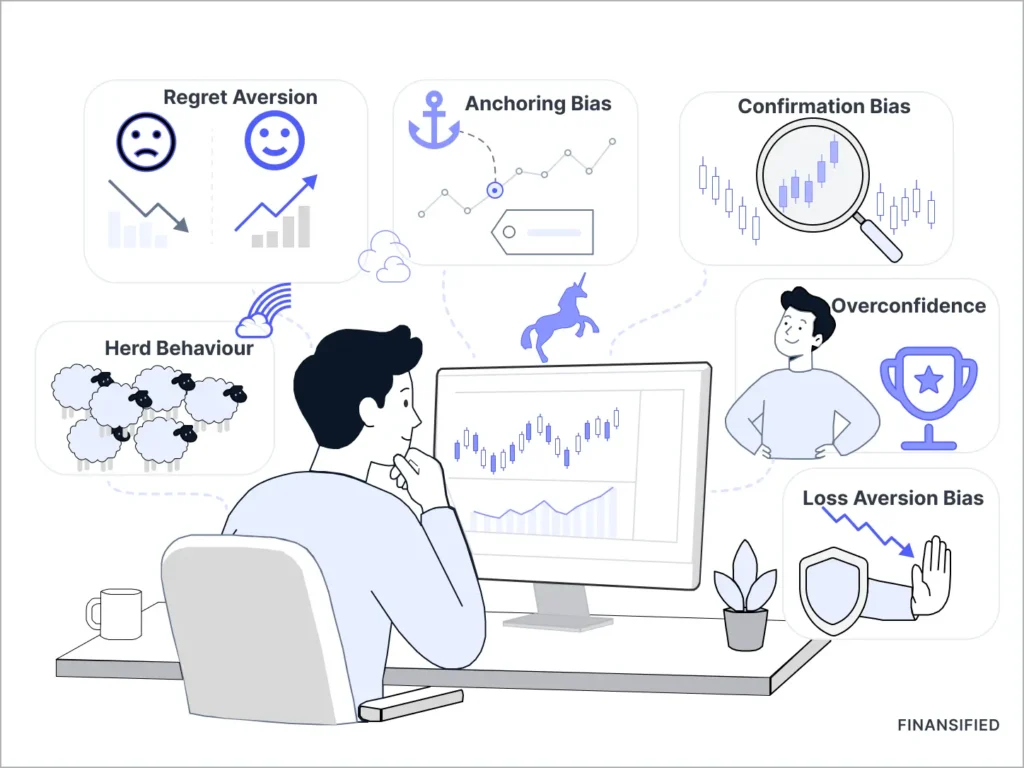
Traditional economics and finance assume rational decision-making, but behavioral finance examines how people and markets actually behave. In practice, investment and trading decisions are often flawed and shaped by both cognitive biases and emotional biases. Financial markets are complex and generate vast amounts of data, which can overwhelm even experienced investors. A single cognitive bias can explain why traders ignore warning signs, while an emotional bias often reveals why losses are held too long. In this article, focused on retail trading and investing, we explore the key biases at play and the steps you can take to manage them.
- Why do we overtrade?
- Why do we hold losing positions longer than we should?
- Why do people follow “gurus”?
Introduction
We’re going to answer these and many more questions by the end of this article, with the goal of helping you make smarter trading and investing decisions. Over the years, working at several retail brokers, we’ve seen hundreds—if not thousands—of retail trading accounts. Whatever can go wrong in retail forex trading, chances are, we’ve seen it. Time and again, the same psychological pitfalls—whether cognitive or emotional—appear across different traders and market conditions.
We’ve observed traders who blew their accounts and blamed nearly everyone but themselves. Many ignored basic risk-management rules and ended up on the losing side. More recently, we’ve spent considerable time browsing social-media platforms like Reddit, where retail traders openly share their wins, losses, frustrations, and strategies. These discussions are sometimes educational, often entertaining, and almost always revealing of underlying cognitive biases and emotional biases.
What stands out is how frequently people talk about “trading psychology.” Overtrading, revenge trading, fear of missing out and attempts to “turn off emotions” come up constantly. “Trading psychology” is the informal term traders often use to describe these and other behavioral patterns. Behavioral finance provides a more structured framework for understanding why these patterns occur and how cognitive and emotional biases influence financial decisions. Many discussions assume there is a simple fix, but these tendencies are often rooted in how our minds process uncertainty, risk and reward.
In this article, we draw on real-world industry experience to examine how fear, regret, impatience and overtrading map onto specific cognitive and emotional biases. We explain why those biases matter and outline practical steps traders can use to identify and, where possible, mitigate them.
What Is Behavioral Finance?
Behavioral finance looks beyond the assumption that we always make perfectly logical investment decisions. It focuses on how real people actually behave in markets. For example, why did you pick stock A instead of stock B? Why did you sell just before the market rallied? These are not just random mistakes; they reflect how our emotions and cognitive biases influence our decisions. Many traditional financial models use simplifying assumptions about rational decision-making and efficient information processing. Behavioral finance examines systematic departures from those assumptions.
Why Behavioral Finance Matters to Traders
As a trader or investor, behavioral finance gives you several concrete advantages. Awareness of our biases may help you recognize when strong emotions rather than logic drive your decisions. That awareness gives you a chance to step back and apply a more disciplined approach.
Behavioral insights enable you to shape an investment plan based not just on returns but on your behavioral tendencies, risk tolerance and goals. That makes your strategy more resilient and customized. Investing and trading aren’t purely mathematical; people don’t always behave in textbook-rational ways. By acknowledging that reality, you build more robust strategies, avoid surprises, and increase the probability of better outcomes.
The next time you consider a trade or review your portfolio, pause and ask: “Am I thinking clearly, or is bias creeping in?” By doing so, you are not just analyzing the numbers; you are also analyzing yourself.
Cognitive Biases in Trading
Many biases affect investor and trader behavior, but they broadly fall into two categories: cognitive biases, which involve errors in thinking, and emotional or affective biases, which are driven primarily by feelings. We will begin with cognitive biases.
Confirmation Bias
Confirmation bias is one of the most common cognitive biases in trading. It is the tendency to seek out, interpret, and remember information that supports our existing beliefs, while ignoring data that challenges them. For example, imagine someone is convinced that a certain trading strategy (like support and resistance) always works. They turn to a trading subreddit such as r/TradingSupportResistance (fictional community), and ask: “Does trading support and resistance work?”, and receive an avalanche of comments like “Yes—of course it works! How dare you doubt this self-evident truth?” Those replies reinforce their belief, and contradictory viewpoints (or data showing it sometimes fails) are brushed aside.
In both trading and investing this bias matters day-to-day. When you only absorb views that confirm your view of a market or strategy, you may ignore warning signs, double down on positions that are going bad, or miss opportunities to hedge effectively. Recognizing confirmation bias helps you question what you believe and gather disconfirming evidence, which is a key step toward better trading decisions.
Anchoring Bias
Anchoring is another classic mental shortcut that trips up investors. It occurs when we rely too heavily on the first piece of information we receive—the “anchor.” We then unconsciously allow that initial information to shape subsequent decisions.
For example, suppose you buy a stock at US$50, and you mentally fix on that entry price as your reference. Later, the stock drops to US$30. Even though fundamentals have changed and the market sentiment is negative, you hold on because you’re anchored to your US$50 purchase price. You may tell yourself, “It has to return to US$50,” because the original purchase price has become your psychological anchor. Or consider a trader who sees a stock hit a 52-week high at US$100 and believes that’s the “normal” level.
When the price falls to US$80, they perceive it as a bargain, even if the company’s outlook has deteriorated. Their view is anchored to the previous high. In trading, this bias is dangerous. When new information arrives (company earnings, economic data, market shifts) but you’re still mentally stuck to the anchor, you may fail to adjust your strategy, hold losing positions too long, or misprice opportunities.
Hindsight Bias
Hindsight bias is the tendency to believe, after an event has occurred, that we knew it was going to happen. Imagine that a stock crashes after several warning signs emerge. Looking back, you tell yourself that you knew all along it was going to collapse, even though you did not reduce your position before the decline. In trading, hindsight bias can show up like this. A trader sees a market correction after it happens, then tells themselves they “knew” it was coming. Because of that belief, they may become overconfident and assume they can predict the next move. This may lead to riskier trades. Even worse, since they think they foresaw the outcome, they may skip reflecting on what they actually did, which means lost learning opportunities.
Availability Bias
Availability bias is another frequent error in trader thinking. It occurs when we overestimate the likelihood of an event because similar examples are easy to recall—often because they are recent, vivid or emotionally charged. You read several news stories about a particular currency pair suddenly plummeting due to a geopolitical shock. Because these recent headlines come to mind so readily, you might assume that the pair is now highly likely to crash again and trade accordingly. Perhaps you avoid it altogether or short it, even though the historical probability of such an event remains low.
Consider another example. A retail trader notices a stock that has risen sharply over the previous month. Because the rise is fresh, impressive and easy to remember, the trader assumes “this kind of jump happens all the time” and piles in—maybe without analyzing whether the fundamentals support it.
Why This Matters
Availability bias can lead you to over-concentrate your trades in what you remember, rather than what the data and probabilities actually support. Tversky and Kahneman showed that people often assess likelihood according to how easily examples come to mind, which can produce systematic errors in judgment.
Herding Bias
When traders see a crowd moving in one direction, it can be tempting to follow—even when they do not fully understand why. Herding bias is the tendency to copy the actions of others rather than make independent decisions based on your own analysis.
In trading, this might look like traders following a new trading guru simply because “everyone else is doing it,” or rushing to exit a position because “everyone is selling,” rather than because of fundamentals. The danger is obvious: you may abandon your process, ignore risk, buy high or sell low—even though the crowd may be late or simply wrong.
To counter herding bias, pause when you feel the urge to follow the crowd, ask “Why is everyone following that guru? What are their credentials and professional experience? Why is everyone buying Bitcoin right now?” and always refer back to your strategy and research.
Overconfidence Bias
Overconfidence bias occurs when traders overestimate the accuracy of their knowledge, forecasts or ability to outperform the market. After several successful trades, a trader may begin to attribute the results entirely to skill while overlooking the possible role of favorable market conditions or chance.
This inflated confidence can lead to excessive trading, larger position sizes and weaker risk controls. In a study of 66,465 brokerage households, Barber and Odean found that the most active investors earned substantially lower net returns than the market. The authors identified overconfidence as one possible explanation for their high trading levels and poor performance.
To guard against overconfidence, evaluate your decisions using a sufficiently long track record rather than a handful of successful trades. Record the reasoning behind each position, compare expected and actual results, and set position-size and risk limits before entering a trade. Confidence should come from a tested process—not from a short winning streak.
Dunning-Kruger Effect
The Dunning-Kruger effect is the final cognitive bias we’ll explore in this guide. It occurs when individuals with relatively low competence or experience in a domain overestimate their skill or knowledge. We have frequently observed a similar pattern among retail traders. After a handful of successful trades, some become convinced that they have developed a consistent edge. Their confidence rises sharply, even though their track record and process may not justify that certainty.
Why Is It Dangerous?
Overestimating your ability means you may ignore warning signals, skip due diligence, reject feedback, or believe you’re invincible. In finance, this misalignment between confidence and competence can lead to large losses.
How Can Traders Guard Against It?
Keep a detailed trading journal. Record not only the outcome of each trade but also your reasoning, expectations and assumptions. Over time, patterns of error or overconfidence become visible. Seek external feedback or peer review. Ask a more experienced trader to review a few trades and provide honest critique.
Use performance metrics rather than subjective feeling. Track measures such as win rate, average risk-to-reward ratio, maximum drawdown, average return, volatility and, where appropriate, the Sharpe ratio. Next time you feel sure you’re “on top of the market”, pause and ask: “Am I genuinely skilled in this area or am I simply feeling confident because of short-term success?”
Emotional Biases in Trading
Emotional biases arise when moods, personal experiences and instinctive reactions influence our decisions more strongly than evidence does. In trading and investing, they can affect how we perceive risk, respond to losses and evaluate opportunities. This section examines three common examples: loss aversion, regret aversion and optimism bias.
Loss Aversion
This is the tendency to prefer avoiding a loss over acquiring an equivalent gain. In simpler terms, losing feels worse than gaining feels good. Classic prospect-theory research found that losses generally weigh more heavily in decision-making than equivalent gains (Prospect Theory by Kahneman and Tversky).
When we go long an asset and that asset at some point dips below where we purchased it, we don’t want to realize the loss. As long as the loss remains unrealized, it may feel merely theoretical rather than “official.”
We have seen many traders holding losing positions far longer than warranted. Instead of accepting the loss and moving on, they hold the position in the hope that it will recover, even when the fundamentals suggest otherwise. That’s loss aversion at work. By recognizing this bias, you can pause and ask yourself: “Am I holding this because the trade still makes sense, or am I holding it because losing feels too painful?” That reflection alone can help you make better, more disciplined choices.
Regret Aversion
Regret aversion is a tendency that many traders may not recognize in themselves. Regret aversion is when you avoid making a decision, or hesitate to act, because you worry you’ll regret it later.
In trading this often shows up like this: you have an opportunity that fits your plan—maybe a trade looks promising, or a stock seems underpriced—but you hold back because you dread the possibility that you might instantly regret the trade if it goes against you. Or you sit on a losing position too long, refusing to cut losses, because selling feels like admitting you were wrong.
The problem is, regret aversion distorts your decision-making. Instead of evaluating a trade on its setup, expected risk and reward, and historical probabilities, you project possible future regret onto the decision and allow fear to influence the outcome. You might miss good opportunities or hold bad positions far longer than you should.
Just like with other biases, being aware of regret aversion is the first step. Ask yourself: “Am I avoiding this trade because it’s a bad idea or because I’m afraid I’ll regret it later?” That simple question can be enough to remind you to stick to your strategy, not your fears.
Optimism Bias
Optimism bias occurs when we believe that our chances of success are higher—and our chances of failure lower—than statistics or experience justify. For example, in trading or investing, this shows up when a trader thinks “I’ve found the next big winner” or “Markets will always reward me because I’ve got the edge”, and they underestimate what might go wrong. The danger? You may under-prepare for setbacks, skip proper risk management or ignore warning signs. Optimism can definitely drive persistence and a positive mindset. But when unchecked it can lead us into positions where the potential downside has not been fully considered.
| Bias | Type | Why It Matters for Traders / Investors | Mitigation / Trader Actions |
|---|---|---|---|
| Confirmation Bias | Cognitive | We tend to favor information that supports what we already believe and ignore contradicting evidence — which can reinforce wrong assumptions or flawed strategies. | Seek out contradictory information before making decisions; challenge your assumptions; require data that disproves your view, not just confirms it. |
| Anchoring Bias | Cognitive | We anchor on initial reference points — like entry price or a past high — which can distort our value and risk calculations. | Regularly re-evaluate based on current data; avoid relying solely on “original” prices; use objective metrics rather than psychological anchors. |
| Overconfidence Bias | Cognitive / Emotional | After a few wins, traders may overestimate their skill, trade bigger positions or skip risk controls — which raises the chance of big losses. | Use a written trading plan; set and respect position-size and risk limits; treat every trade as uncertain; review performance objectively. |
| Loss Aversion | Emotional | The pain of losses often feels stronger than the pleasure of equivalent gains — causing traders to hold losing positions too long, or avoid reasonable risk. | Use stop-loss orders; establish clear exit rules before entering a trade; focus on long-term performance instead of short-term swings. |
| Herd / Bandwagon Effect | Cognitive + Emotional/Social | Following the crowd instead of independent analysis — especially during hype or panic — can lead to buying high and selling low. | Rely on your own research and plan, not on crowd sentiment; question popular narratives; avoid trading just because “everyone else is doing it.” |
| Regret Aversion | Emotional | Fear of future regret can cause hesitation or lead to holding bad positions too long, skewing objective decision-making. | Frame trades probabilistically rather than emotionally; pre-define entry/exit rules; reflect on emotional reactions separately from analysis. |
| Availability Bias | Cognitive | We overweight events that are recent, vivid, or memorable — which distorts our perception of risk and likelihood. | Rely on long-term data rather than recent vivid events; diversify information sources; avoid decision-making based solely on recent anecdotes. |
Conclusions
We’ve covered several examples of cognitive biases in the first part of our article, before moving on to emotional trading behaviors. It’s crucial to acknowledge that this is just the tip of the iceberg. The field of behavioral finance continues to evolve and encompasses many more cognitive and emotional distortions than we could explore here.
If you spend time in retail-trading communities, on forums, subreddits and chats you’ll see how often discussions center on “trading psychology”, “overtrading”, or “revenge trading”. Traders often ask how to turn these things off. The reality is that many of these tendencies arise from deeply rooted features of human cognition and emotion, so changing them is rarely as simple as “turning them off.”
Can We Correct All Biases?
The short answer is, not entirely. Some cognitive biases can be mitigated through awareness, structured decision-making and disciplined processes. Emotional biases tied to mood, identity and responses to risk or reward may be more difficult to manage. All we can realistically do is try: build systems, reflect on your behavior, remain humble, and accept that you may never fully eliminate these distortions.
By building disciplined systems and remaining mindful of how you think and feel, you put yourself in a better position to navigate markets wisely. Investing and trading are not only about numbers and strategy; they also require aligning your decision-making process with your psychology, emotions and tolerance for risk.
Disclaimer: This article is for educational purposes only and does not constitute financial or investment advice. Trading forex, cryptocurrencies, and other financial instruments involves a high level of risk and may not be suitable for all investors. Always conduct your own due diligence and consult with a licensed financial advisor before making any investment decisions.
REFERENCES:
- Yang, Liyan, Loss Aversion in Financial Markets (August 2019). Journal of Mechanism and Institution Design, 2019, 4(1), 119 –137., Available at SSRN: https://ssrn.com/abstract=3531959
- Kahneman, Daniel; Tversky, Amos (1979). “Prospect Theory: An Analysis of Decision under Risk” (PDF). Econometrica. 47 (2): 263–291. CiteSeerX 10.1.1.407.1910. doi:10.2307/1914185. ISSN 0012-9682. JSTOR 1914185
- Tversky, A., & Kahneman, D. (1974). Judgment under Uncertainty: Heuristics and Biases. Science, 185(4157), 1124–1131. DOI: 10.1126/science.185.4157.1124.
- J Kruger 1, D Dunning: Unskilled and unaware of it: how difficulties in recognizing one’s own incompetence lead to inflated self-assessments
- Barber, B. M., & Odean, T. (2000). Trading Is Hazardous to Your Wealth: The Common Stock Investment Performance of Individual Investors. The Journal of Finance, 55(2), 773–806. DOI: 10.1111/0022-1082.00226.