Expansionary vs. Contractionary Monetary Policy: How They Work

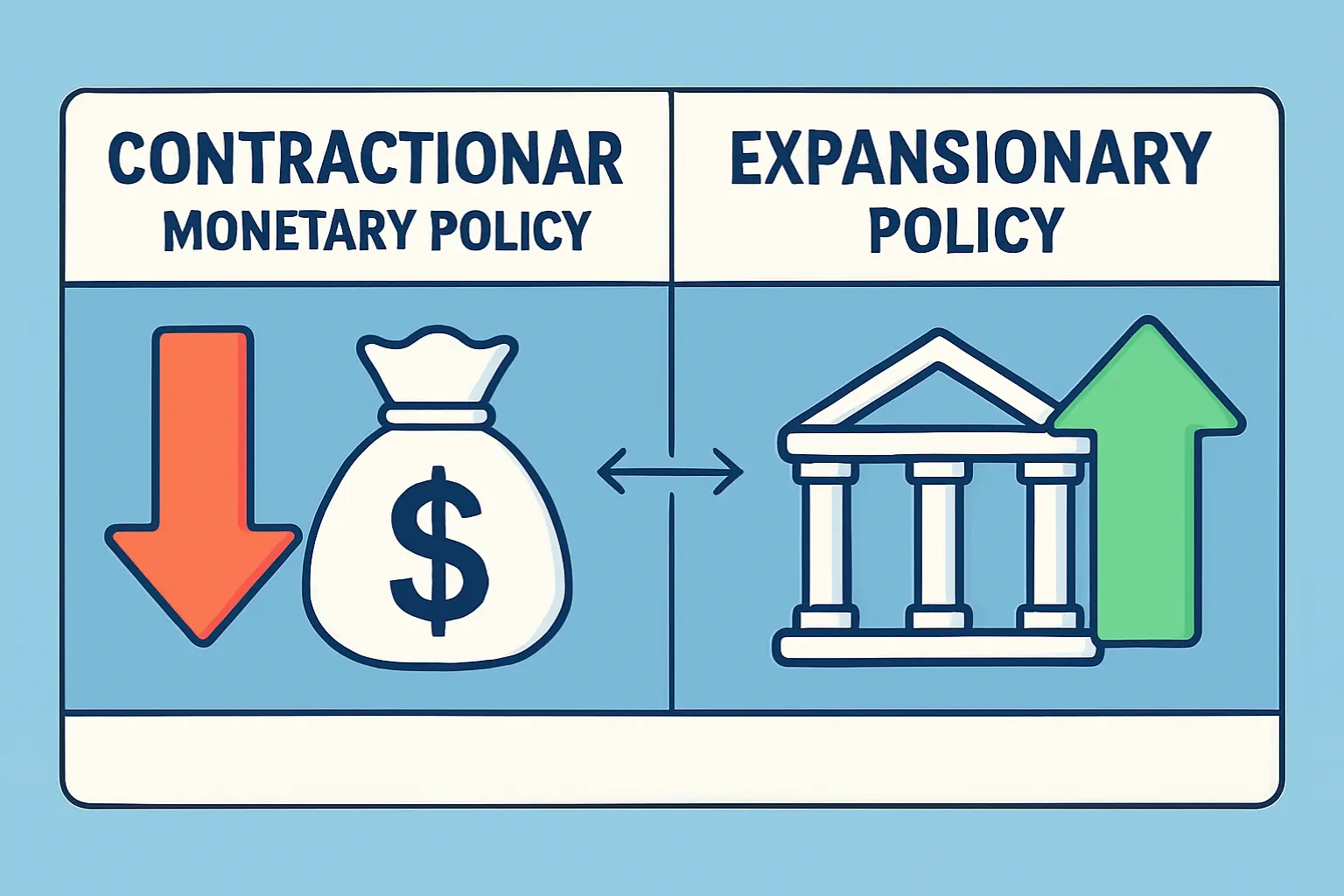
Picture showing expansionary and contractionary policy

Expansionary and contractionary monetary policy describe two broad ways central banks can influence economic activity and inflation.

Expansionary monetary policy makes financial conditions more accommodative. Central banks typically do this by lowering policy interest rates or, in some circumstances, using other tools such as asset purchases. Lower borrowing costs and easier financial conditions can support household spending, business investment, employment, and economic activity.

Contractionary monetary policy does the opposite. Central banks typically raise policy rates or otherwise tighten financial conditions when they want to restrain demand and reduce persistent inflationary pressure.

The distinction sounds simple, but monetary policy does not work by mechanically adding or removing a fixed quantity of money from the economy. In modern interest-rate-based monetary systems, policy decisions first influence short-term interest rates and broader financial conditions. Those changes then affect borrowing, saving, spending, investment, employment, and ultimately inflation.

It is also misleading to assume that a low interest rate is automatically expansionary or a high rate is automatically contractionary. The stance of monetary policy depends on economic conditions and, among other things, how the policy rate compares with the economy’s estimated neutral interest rate.

Quick comparison

Expansionary vs. Contractionary Monetary Policy at a Glance

Both policy stances influence financial conditions and aggregate demand, but they push the economy in opposite directions.

Comparison of expansionary and contractionary monetary policy
Policy featureExpansionary monetary policyContractionary monetary policy
Main objective Expansionary Support economic activity and/or raise inflation toward target Contractionary Restrain demand and reduce inflationary pressure
Typical policy-rate move Expansionary Lower rates Contractionary Raise rates
Financial conditions Expansionary Generally become easier Contractionary Generally become tighter
Borrowing costs Expansionary Generally fall Contractionary Generally rise
Household spending and business investment Expansionary Tends to be supported Contractionary Tends to be restrained
Aggregate demand Expansionary Tends to increase Contractionary Tends to slow
Employment Expansionary Can be supported as activity strengthens Contractionary Can weaken as demand slows
Inflation pressure Expansionary Can increase over time Contractionary Can decrease over time
Typical economic setting Expansionary Weak demand, economic slowdown, or inflation below target Contractionary Excess demand, overheating, or persistent inflation above target

Important: These are typical effects rather than fixed rules. The actual stance of monetary policy also depends on economic conditions and where the policy rate stands relative to the estimated neutral interest rate.

These effects are tendencies rather than mechanical outcomes. Monetary policy works with lags, and its impact depends on factors such as the health of the financial system, expectations, existing debt, global conditions, and the source of inflation.

What Is Expansionary Monetary Policy?

Expansionary monetary policy, also called monetary easing or accommodative monetary policy, is a policy stance intended to support economic activity and, when necessary, push inflation back toward a central bank’s target.

The most common conventional tool is a reduction in the policy interest rate. Lower policy rates tend to feed through to other interest rates and broader financial conditions, making borrowing cheaper and saving relatively less attractive. This can encourage households to spend and businesses to invest.

Central banks are more likely to adopt an expansionary stance when economic demand is weak, unemployment is elevated, or inflation is running below target or expected to fall below it. The precise response depends on the central bank’s mandate and the economic circumstances.

Lowering interest rates is not the only form of monetary easing. When conventional interest rates have little room to fall, central banks may use additional tools, including large-scale asset purchases. We will return to these unconventional measures later.

How Expansionary Monetary Policy Works

A simplified transmission process looks like this:

Central bank eases policy

Policy and market interest rates fall

Financial conditions become more accommodative

Borrowing becomes cheaper and saving less attractive

Household spending and business investment tend to increase

Aggregate demand and economic activity strengthen

Employment and inflationary pressure may rise over time

This process is known as the monetary policy transmission mechanism.

The effects are neither immediate nor guaranteed. Changes in policy rates pass through the financial system at different speeds, and their impact depends on factors such as household and corporate debt, lending conditions, expectations, exchange rates, and the overall state of the economy.

Expansionary monetary policy should therefore be understood as an attempt to influence financial conditions and aggregate demand, not as a mechanical process in which a central bank simply creates more money and spending automatically rises.

What Is Contractionary Monetary Policy?

Contractionary monetary policy, also called monetary tightening or restrictive monetary policy, is a policy stance intended to restrain demand and reduce persistent inflationary pressure.

The conventional approach is to raise the policy interest rate. Higher policy rates tend to push borrowing costs higher across the economy. Saving may become more attractive, while households and businesses may become less willing to borrow, spend, or invest.

Central banks are more likely to tighten policy when inflation is persistently above target, particularly when strong demand or rising inflation expectations threaten price stability.

The objective is not normally to stop economic activity. It is to slow demand sufficiently to bring spending and productive capacity into better balance and reduce inflationary pressure.

How Contractionary Monetary Policy Works

The transmission mechanism broadly runs in the opposite direction:

Central bank tightens policy

Policy and market interest rates rise

Financial conditions become tighter

Borrowing becomes more expensive and saving more attractive

Household spending and business investment tend to slow

Growth in aggregate demand moderates

Pressure on employment, wages, and prices may ease

Inflation tends to decline over time

Again, this is a simplified chain rather than a mechanical formula. A rate increase today does not immediately produce a predictable change in inflation tomorrow. Monetary policy operates with lags, and the strength of its effects can vary considerably across economic conditions.

This is one reason central banks base policy on forecasts and a broad range of economic information rather than reacting mechanically to a single inflation or employment number.

Monetary policy transmission

How Monetary Policy Moves Through the Economy

Switch between expansionary and contractionary policy to see how a change in the policy stance can pass through financial conditions, household and business decisions, aggregate demand, and inflation.

Expansionary: policy aims to make financial conditions more accommodative.

1

Policy decision

Lower policy rates

The central bank reduces the degree of monetary restraint or adds accommodation.

↓ Policy rate
2

Financial conditions

Market rates tend to fall

Borrowing costs, asset prices, credit conditions, and exchange rates can adjust.

Easier conditions
3

Households & businesses

Borrowing becomes cheaper

Financing becomes more attractive, while saving may become relatively less rewarding.

More incentive to spend
4

Spending & investment

Spending tends to strengthen

Household consumption and business investment may increase over time.

↑ Consumption & investment
5

Demand & activity

Aggregate demand strengthens

Stronger demand can support output and employment when spare capacity is available.

↑ Economic activity
6

Inflation over time

Inflation pressure can rise

If demand strengthens relative to productive capacity, inflationary pressure may increase.

↑ Inflation pressure
Finansified Evidence-based finance

How Do We Know Whether Monetary Policy Is Expansionary or Contractionary?

A central bank can cut interest rates without necessarily making monetary policy expansionary. Likewise, raising rates does not automatically mean that policy has become contractionary.

To assess the policy stance, economists often compare the current policy rate with an estimate of the neutral interest rate.

The neutral rate is the interest rate consistent with an economy operating around its sustainable potential while inflation remains stable. At that level, monetary policy is neither deliberately stimulating demand nor restraining it.

In simplified terms:

Policy rate below neutral → generally expansionary

Policy rate near neutral → broadly neutral

Policy rate above neutral → generally contractionary

This comparison explains why the absolute level of interest rates can be misleading. Suppose the estimated nominal neutral rate were 3%. A policy rate of 5% would generally represent a restrictive stance. If the central bank then cut the rate to 4.5%, monetary policy would become less restrictive, but it would not necessarily become expansionary.

By contrast, a 2% policy rate could be accommodative under the same assumptions, even though 2% might appear relatively high or low when compared with rates from another period.

The Neutral Rate Cannot Be Observed Directly

There is an important complication: nobody can observe the neutral rate in real time.

Economists have to estimate it from economic data, and different models can produce different answers. Moreover, the neutral rate can change as productivity, demographics, saving and investment behavior, fiscal conditions, risk preferences, and other structural forces evolve.

Economists often use the term r-star (r*) for the real neutral interest rate—that is, the neutral rate after adjusting for inflation. To compare it with a nominal policy rate, we also need to account for expected inflation. As a rough conceptual relationship:

Nominal neutral rate ≈ real neutral rate (r*) + expected inflation

However, this is not a shortcut for calculating the neutral rate. The difficult part is estimating r* itself.

For that reason, we should not treat any single neutral-rate estimate as a precise dividing line between “easy” and “tight” monetary policy. Instead, policymakers use it as one reference point alongside inflation, employment, economic growth, financial conditions, expectations, and the broader economic outlook.

The neutral rate therefore gives us a better way to think about monetary policy than simply asking whether interest rates are rising or falling. A rate cut can leave policy restrictive, while a rate increase can leave it accommodative. What matters is the stance of policy relative to the economy, not the direction of the latest interest-rate move alone.

Why the Source of Inflation Matters

Contractionary monetary policy is usually easier to justify when inflation reflects excess demand. If households, businesses, and governments are collectively trying to spend more than the economy can sustainably produce, prices tend to come under upward pressure.

Higher interest rates can help restore balance. More expensive borrowing and tighter financial conditions reduce some consumption and investment, slowing aggregate demand. As a result, businesses face less pressure to raise prices, while tight labor-market conditions may gradually ease.

However, not every inflation shock starts with excessive demand.

Demand Shocks and Supply Shocks Are Different

Consider a sharp increase in oil prices caused by a disruption to global supply. Energy becomes more expensive, transportation costs rise, and businesses may pass some of those higher costs on to consumers. Inflation can therefore increase even as economic growth weakens.

Raising interest rates cannot produce more oil, repair a disrupted supply chain, or increase the economy’s productive capacity. Monetary policy primarily influences demand.

That creates a difficult trade-off. Tightening policy can reduce the demand that firms face, which may eventually lessen inflationary pressure. At the same time, however, higher rates can add to the slowdown already caused by the supply shock.

For this reason, central banks may sometimes look through the direct effects of a temporary supply shock rather than trying to offset every short-term increase in inflation.

When a Supply Shock Becomes a Monetary Policy Problem

Looking through a shock does not mean ignoring it.

Suppose higher energy prices persist. Businesses may begin passing rising costs into a wider range of goods and services. Workers may seek larger wage increases to recover lost purchasing power, while firms adjust their prices more frequently. Meanwhile, households and businesses could begin expecting inflation to remain elevated.

At that point, an initially narrow supply shock can develop second-round effects and create broader, more persistent inflation.

The monetary policy response may then need to change. Even though higher interest rates cannot fix the original supply problem, tighter policy can restrain demand and help prevent temporary inflation from becoming embedded in wage-setting, pricing behavior, and inflation expectations.

Therefore, policymakers have to ask more than whether inflation is high. They also need to consider:

  • What caused the inflation?
  • How persistent is the shock likely to be?
  • How strong is underlying demand?
  • Are price pressures spreading across the economy?
  • Do longer-term inflation expectations remain anchored?

This helps explain why central banks do not follow a mechanical rule such as “inflation rises, therefore raise rates.” The same increase in headline inflation can require a different policy response depending on its source, persistence, and wider effects on the economy.

What Happens When Interest Rates Can’t Be Cut Much Further?

Central banks usually respond to weak demand by lowering their policy interest rate. Eventually, however, rates can approach a level beyond which further cuts provide little additional stimulus or become increasingly difficult to implement.

Economists call this the effective lower bound (ELB).

The term is more accurate than “zero lower bound” because zero is not necessarily a hard limit. Several central banks have used slightly negative policy rates. Even so, there is a practical limit to how far rates can fall before the benefits of additional cuts diminish or unwanted side effects become more important.

Reaching that limit does not mean monetary policy has no options left. Central banks can turn to other tools that influence longer-term interest rates, expectations, and broader financial conditions.

Quantitative Easing

One of the best-known tools is quantitative easing (QE).

Under QE, a central bank purchases financial assets—typically longer-term government bonds and, in some programs, other securities. It pays for those purchases by creating central bank reserves electronically.

This is sometimes described loosely as “printing money,” but that phrase can give the wrong impression. QE does not require the central bank to print banknotes and hand them to commercial banks or the public.

Instead, it changes the composition of financial assets held by the private sector.

Suppose a pension fund sells a government bond as part of a central bank’s QE program. Because the pension fund does not itself hold an account at the central bank, the transaction takes place through its commercial bank. The central bank credits the commercial bank’s reserve account, while the commercial bank credits the pension fund’s deposit account.

As a result, the private sector holds fewer of the bonds targeted by the central bank and more highly liquid financial claims.

How Can QE Affect the Economy?

Asset purchases can influence the economy through several channels.

First, large purchases raise demand for the targeted bonds. Other things equal, higher bond prices mean lower bond yields. Because government bond yields help determine borrowing costs elsewhere in the financial system, lower yields can contribute to easier financing conditions for households and businesses.

QE can also encourage portfolio rebalancing. Investors who sell bonds to the central bank may use the proceeds to purchase other assets, such as corporate bonds or equities. That additional demand can push down yields on other securities and reduce the cost of raising finance.

In addition, an asset-purchase program can affect expectations about future monetary policy. If investors interpret QE as a signal that policy will remain accommodative, expected future interest rates may fall, placing further downward pressure on longer-term borrowing costs.

The simplified transmission therefore looks something like this:

Central bank purchases longer-term assets

Central bank reserves increase

Supply of those assets available to private investors falls

Bond yields and other financing costs may decline

Broader financial conditions become more accommodative

Spending and investment may receive additional support

QE Does Not Work by Giving Banks Money to Lend

A common explanation says that QE gives commercial banks additional reserves, which banks can then “lend out” to households and businesses. That description is misleading.

Commercial banks do not lend central bank reserves directly to households or ordinary businesses. Reserves are primarily used for payments and settlement between eligible financial institutions and the central bank.

Moreover, bank lending does not mechanically depend on banks first receiving additional reserves. When a commercial bank approves a loan, it normally creates a corresponding bank deposit. Whether banks expand lending depends on factors such as creditworthy demand, expected returns, capital and liquidity constraints, risk, and broader economic conditions.

QE can still make credit conditions easier. However, it does so mainly by influencing asset prices, yields, expectations, liquidity, and financial conditions rather than through a simple chain of more reserves → more bank loans.

QE Is Not Unlimited Monetary Stimulus

Like conventional interest-rate policy, QE has uncertain effects. Its impact can vary according to market conditions, the assets being purchased, investors’ expectations, and the state of the economy.

Central banks can also reverse balance-sheet expansion when monetary conditions need to tighten. They may allow purchased securities to mature without replacing them or actively sell assets. This process is commonly known as quantitative tightening (QT).

QE therefore extends the monetary-policy toolkit when conventional rate cuts become constrained. It does not remove the basic challenge facing policymakers: influencing financial conditions strongly enough to affect demand and inflation without knowing the exact size or timing of the eventual economic response.

Expansionary and Contractionary Monetary Policy in Practice

The Federal Reserve’s response to the COVID-19 shock and the subsequent inflation surge provides a useful real-world example of both policy stances.

2020: A Shift Toward Expansionary Monetary Policy

When the pandemic disrupted economic activity and financial markets in early 2020, the Federal Reserve moved rapidly to make monetary policy more accommodative.

In two emergency decisions during March, the Fed cut the target range for the federal funds rate by a total of 1.5 percentage points, bringing it down to 0%–0.25%.

At the same time, the central bank began large-scale purchases of Treasury securities and agency mortgage-backed securities. Initially, those purchases also aimed to restore smooth functioning in stressed financial markets. As the program continued, however, asset purchases helped maintain accommodative financial conditions and support the economic recovery.

This was a clear example of expansionary monetary policy:

Policy rates fell

Asset purchases expanded

Financial conditions became more accommodative

Policy aimed to support credit, spending, employment, and economic activity

Importantly, the Fed was responding to an extraordinary collapse in economic activity rather than trying to stimulate an economy already operating near capacity.

2022–2023: A Shift Toward Contractionary Monetary Policy

By 2022, policymakers faced a very different problem.

Economic activity and employment had recovered substantially, while inflation remained far above the Fed’s 2% longer-run objective. Price pressures reflected a combination of strong demand, pandemic-related supply disruptions, higher energy prices, and increasingly broad inflation.

The Fed therefore began moving in the opposite direction.

In March 2022, it raised the federal funds target range to 0.25%–0.50%, marking the first increase of the tightening cycle. Further rate increases followed. By July 2023, the target range had reached 5.25%–5.50%.

Balance-sheet policy also changed direction. The Fed stopped expanding its securities holdings and, beginning in June 2022, allowed increasing amounts of Treasury and agency securities to mature without fully reinvesting the proceeds. This process reduced the size of its securities portfolio over time.

The policy stance had therefore shifted toward contraction:

Policy rates rose sharply

Balance-sheet expansion ended and runoff began

Borrowing costs and broader financial conditions tightened

Policy aimed to moderate demand and reduce inflationary pressure

The Same Tools Can Work in Opposite Directions

The contrast highlights an important point: expansionary and contractionary monetary policy are not permanent central-bank philosophies.

They are policy stances chosen in response to economic conditions.

In 2020, the Fed faced collapsing activity, severe uncertainty, and financial-market stress. Expansionary policy aimed to support the economy and preserve the transmission of credit.

Two years later, persistent inflation had become the dominant concern. The central bank responded by raising interest rates and reducing the degree of monetary accommodation.

The objectives and circumstances changed, so the direction of policy changed with them.

This example also shows why simply asking whether a central bank is “cutting” or “raising” rates does not tell the whole story. Policymakers consider inflation, employment, economic activity, expectations, financial conditions, and risks to the outlook when deciding how restrictive or accommodative policy should be.

Limits of Monetary Policy

Monetary policy can have a powerful influence on economic activity and inflation, but central banks do not control either outcome with precision. Policymakers make decisions under uncertainty, and the effects of those decisions can take considerable time to appear.

Several limitations are especially important.

Monetary Policy Works With Long and Variable Lags

A change in the policy rate does not immediately translate into an equivalent change in economic growth or inflation.

Financial markets may react quickly, but households and businesses often respond more gradually. Existing mortgages may remain fixed for years, companies may delay investment decisions, and changes in employment or wage growth can take even longer to develop.

Research therefore continues to support the idea of long and variable lags. The strongest effects of a monetary policy change on economic activity and inflation may not appear for a year or more.

This creates a difficult timing problem. Central banks cannot simply wait until inflation reaches an undesirable level and then expect a rate increase to reverse it immediately. Instead, monetary policy has to be forward-looking.

However, forecasts can be wrong. Tightening too little may allow inflationary pressure to persist, while tightening too aggressively can weaken economic activity more than intended.

Policymakers Do Not Know the Neutral Rate With Precision

As discussed earlier, the neutral interest rate provides an important benchmark for judging whether monetary policy is accommodative or restrictive. Yet the neutral rate cannot be observed directly.

Economists estimate it, and those estimates can change as new data arrive or as the economy itself evolves.

That uncertainty matters in practice. A central bank may believe its policy rate is substantially above neutral and therefore restrictive. If the true neutral rate is higher than estimated, however, policy may be providing less restraint than policymakers think.

The opposite mistake is also possible.

As a result, monetary policy cannot be calibrated with the precision of a thermostat. Estimates of the neutral rate, potential output, labor-market slack, and other important economic variables all contain uncertainty.

The Strength of Monetary Transmission Can Change

Even when policymakers know the direction in which they want to move the economy, they cannot know exactly how strongly a particular interest-rate change will affect it.

The transmission mechanism depends on the circumstances.

For example, higher rates may have a stronger effect when many households need to refinance debt than when most borrowers have long-term fixed-rate loans. Banks may also tighten credit standards independently of the central bank, while changes in market expectations can amplify or offset part of a policy move.

Consequently, the same one-percentage-point rate increase need not produce the same economic response in two different periods.

Central banks therefore monitor how policy is passing through financial markets, lending conditions, household finances, business investment, employment, and inflation rather than assuming a fixed relationship between interest rates and the economy.

Monetary Policy Cannot Fix Every Economic Problem

Interest rates primarily influence aggregate demand and financial conditions. They cannot directly increase oil production, repair damaged infrastructure, eliminate a semiconductor shortage, or make workers more productive.

This limitation becomes especially important during supply shocks.

A central bank may be able to restrain the demand response to rising prices and prevent inflation expectations from becoming unanchored. However, tighter monetary policy cannot remove the original supply constraint and may further weaken economic activity.

Likewise, expansionary monetary policy can support demand during a downturn, but it cannot by itself solve structural problems such as weak productivity growth or shortages of productive capacity.

Policymakers Must Balance the Risk of Doing Too Much Against Doing Too Little

Ultimately, monetary policy involves risk management rather than precise economic control.

When inflation is too high, tightening too slowly may allow price pressures to persist or expectations to become less anchored. On the other hand, excessive tightening can unnecessarily suppress spending, investment, and employment.

Similar trade-offs apply when central banks ease policy. Acting too slowly can deepen an economic downturn, while providing too much stimulus for too long can contribute to excessive demand and renewed inflationary pressure.

For this reason, central banks continuously reassess incoming data, forecasts, financial conditions, and risks to the outlook. Expansionary and contractionary monetary policy are therefore not automatic responses to individual economic indicators. They are policy choices made under uncertainty, with effects that unfold gradually and can differ from one economic cycle to another.

Why Monetary Policy Matters for Financial Markets

Monetary policy affects much more than borrowing costs for households and businesses. Changes in interest rates—and expectations about where rates are heading—can influence bond yields, equity valuations, exchange rates, credit conditions, and other financial-market prices.

These market effects form part of the monetary policy transmission mechanism. In fact, financial markets often react much faster than the broader economy because investors continuously update their expectations about future interest rates, inflation, economic growth, and central-bank policy.

However, the relationship is not mechanical. Markets respond to new information relative to what investors had already expected, not simply to whether a central bank raises or cuts rates.

Bonds and Interest Rates

Bond markets have one of the most direct connections to monetary policy.

Central banks typically control or influence very short-term interest rates. Expectations about the future path of those rates then help shape yields further along the maturity spectrum.

For example, if investors suddenly expect policy rates to remain higher for longer, yields on government bonds may rise even if the central bank leaves its current policy rate unchanged.

The opposite can happen as well. A central bank may raise rates today, yet longer-term bond yields could fall if investors interpret the decision as reducing future inflation or believe the tightening cycle is close to an end.

Therefore, the current policy rate alone does not determine bond yields. Investors also consider:

  • expected future interest rates;
  • expected inflation;
  • the economic outlook;
  • term premiums;
  • credit and liquidity risks.

This is why central-bank statements, economic projections, and press conferences can move bond markets even when policymakers make no change to the headline interest rate.

Equities

Monetary policy can also influence equity prices.

One channel operates through discount rates. A stock represents a claim on future corporate cash flows. When the rates investors use to discount those future cash flows rise, their present value generally falls, all else equal.

Higher interest rates can also increase financing costs for companies and weaken household or business demand. Both effects may weigh on expected corporate profits.

Expansionary policy can work in the opposite direction by lowering discount rates and supporting financial conditions and economic activity.

However, “lower rates are good for stocks” and “higher rates are bad for stocks” are not reliable trading rules.

Equity prices respond simultaneously to earnings expectations, risk premiums, economic growth, inflation, investor sentiment, and many other factors. A rate cut prompted by a severe deterioration in the economy, for example, may coincide with falling stock prices because investors are more concerned about weakening profits than about lower interest rates.

Similarly, equities can rise while bond yields increase if stronger corporate earnings or an improved growth outlook outweigh the effect of higher discount rates.

Foreign Exchange

Monetary policy also matters for exchange rates, but FX is inherently a relative market.

A currency’s value does not depend simply on whether its own central bank is raising or cutting rates. What matters is how expected returns in one currency compare with those available in others.

Suppose markets begin to expect the Federal Reserve to keep interest rates higher than previously anticipated while expectations for the European Central Bank remain unchanged. The resulting shift in expected interest-rate differentials may increase the relative attractiveness of dollar-denominated assets and support the U.S. dollar.

However, much depends on what markets had already priced in.

If investors fully expected a rate increase before the announcement, the actual decision may produce little reaction. By contrast, an unexpected change in the policy outlook can cause a much larger adjustment because investors suddenly have to reprice future interest-rate differentials.

Exchange rates also respond to economic growth, inflation, risk sentiment, capital flows, political developments, terms of trade, and many other variables. Therefore, monetary policy is an important FX driver, but it is never the only one.

Expectations Often Matter More Than the Headline Decision

This leads to one of the most important lessons for interpreting central-bank decisions:

Markets trade the difference between what happened and what they expected to happen.

Consider two hypothetical announcements.

In the first, a central bank raises its policy rate by 0.25 percentage points exactly as markets expected and provides no new information about future policy. Asset prices may move very little.

In the second, the bank leaves rates unchanged but unexpectedly signals that inflation risks have increased and further tightening is likely. Bond yields and the currency could rise because expectations for the future policy path have changed.

For this reason, financial-market participants pay attention not only to the rate decision itself but also to economic projections, policy statements, voting patterns, press conferences, and other central-bank communication.

Understanding monetary policy therefore helps investors interpret why financial conditions and asset prices may be changing. It does not provide a reliable formula for predicting the direction of bonds, equities, or currencies.

Expansionary vs. Contractionary Monetary Policy: The Bottom Line

Expansionary and contractionary monetary policy work in opposite directions, but both serve the same broader purpose: helping a central bank achieve its economic objectives.

Expansionary monetary policy aims to make financial conditions more accommodative. Central banks usually lower policy rates when they want to support weak demand, employment, or inflation that is running below target. If conventional rate cuts become constrained, additional measures such as quantitative easing can provide further accommodation.

Contractionary monetary policy aims to restrain demand and reduce persistent inflationary pressure. Higher policy rates raise borrowing costs and tighten financial conditions, which can slow spending and investment and eventually ease pressure on prices.

However, the distinction is not as simple as “rates down means expansionary” and “rates up means contractionary.” The policy stance depends partly on where interest rates stand relative to the economy’s neutral rate. A central bank can cut rates while policy remains restrictive, just as it can raise rates while conditions remain relatively accommodative.

Economic circumstances matter as well. Monetary policy is generally better suited to managing demand than repairing supply shortages. Moreover, its effects arrive with uncertain lags, and policymakers cannot observe important variables such as the neutral interest rate with precision.

For financial markets, these same uncertainties help explain why central-bank decisions do not produce predictable movements in bonds, equities, or currencies. Investors respond to the new information contained in a decision—especially changes in expectations about future policy—rather than to the headline rate move alone.

The most useful way to think about expansionary and contractionary monetary policy is therefore as changes in the degree of monetary accommodation or restraint.

One supports demand and economic activity when conditions warrant it. The other restrains demand when inflationary pressure becomes excessive.

Neither offers policymakers precise control over the economy, but together they form the core of how modern central banks adjust monetary conditions as economic circumstances change.

Frequently Asked Questions

Quick answers to common questions about expansionary and contractionary monetary policy.

What is expansionary monetary policy?

Expansionary monetary policy is a policy stance designed to make financial conditions more accommodative and support economic activity. Central banks typically lower policy interest rates when demand is weak or inflation is below target. When conventional rate cuts become constrained, they may also use tools such as quantitative easing.

What is contractionary monetary policy?

Contractionary monetary policy is a policy stance designed to restrain demand and reduce persistent inflationary pressure. Central banks typically raise policy rates, which tends to increase borrowing costs, tighten financial conditions, and slow household spending and business investment.

What is an example of contractionary monetary policy?

The Federal Reserve's 2022–2023 tightening cycle is a clear example. Beginning in March 2022, the Fed raised the federal funds target range repeatedly as inflation remained well above its 2% objective. By July 2023, the range had reached 5.25%–5.50%. The Fed also began reducing its securities holdings through balance-sheet runoff.

Does expansionary monetary policy always mean lower interest rates?

Not necessarily. A rate cut makes monetary policy more accommodative than it was before, but policy can remain restrictive if the resulting rate is still above the economy's estimated neutral rate. Central banks can also provide accommodation through other tools, including asset purchases, when conventional rates have little room to fall.

How does monetary policy affect inflation?

Monetary policy affects inflation mainly by changing interest rates, financial conditions, and aggregate demand. Easier policy can support spending and investment, while tighter policy can restrain them. However, interest rates cannot directly fix supply shortages, and the effect of policy on inflation usually arrives with uncertain and sometimes lengthy lags.

References

Selected central-bank and institutional sources used in this article.

  1. Federal Reserve Bank of St. Louis Expansionary and Contractionary Monetary Policy Definitions, policy-rate transmission, aggregate demand, employment and inflation.
  2. Bank of England About a Rate of (General) Interest: How Monetary Policy Transmits Monetary-policy transmission through interest rates, financial conditions, expectations, asset prices and the real economy.
  3. Federal Reserve Bank of New York Measuring the Natural Rate of Interest Definition and estimation of the real natural interest rate, or r-star.
  4. Bank of England Money Creation in the Modern Economy How commercial banks create deposits and why bank lending does not mechanically multiply central-bank reserves.
  5. Bank of England Quantitative Easing and Quantitative Tightening QE as an asset swap, its transmission through yields and financial conditions, and the mechanics of quantitative tightening.
  6. Petar Chobanov, Bulgarian National Bank — hosted by BIS Back to Basics: Interest Rates, Price Stability and Supply-Side Shocks Discussion of supply shocks, inflation persistence, expectations and monetary-policy trade-offs.
  7. Federal Reserve Board Transmission of Monetary Policy Evidence and discussion of monetary-policy transmission and the timing of effects on economic activity and inflation.
  8. Federal Reserve Board Federal Reserve FOMC Statement — March 15, 2020 Emergency policy easing and large-scale purchases of Treasury securities and agency mortgage-backed securities during the COVID-19 shock.
  9. Federal Reserve Board Federal Reserve FOMC Statement — March 16, 2022 Beginning of the 2022 federal-funds-rate hiking cycle as inflation remained elevated.